
We run your interior fit-out —
from first idea to last piece of furniture.
An independent interior fitting contractor in Munich, on your side from first sketch to keys. We bring designers, architects, and craftsmen to one table, hold schedules and budgets, check every seam — and hand you back a move-in-ready home. Not a finished construction site.
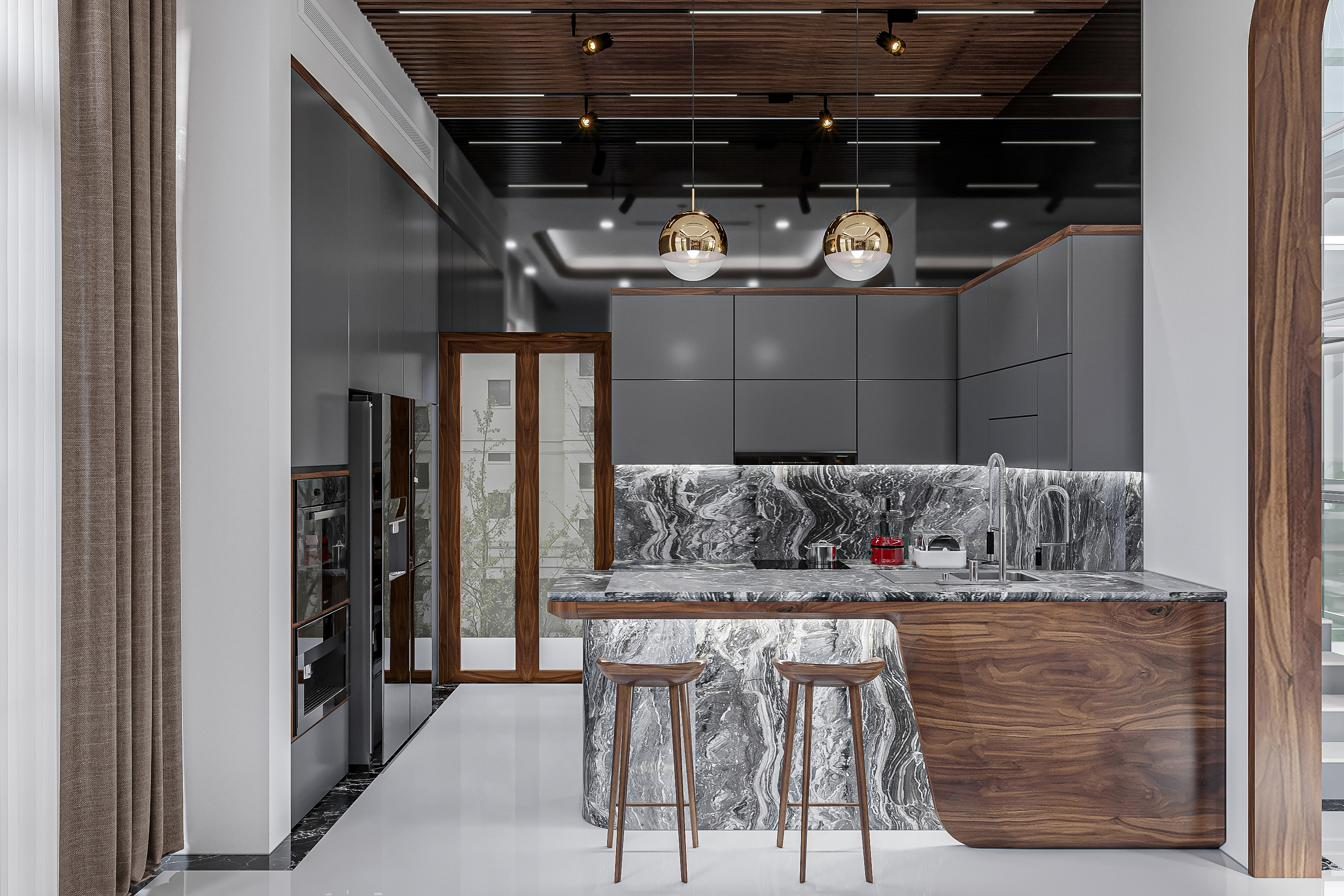
One person responsible for everything — except the design itself.
In English-speaking markets, this role is well established: Owner's Representative. Independent. Fixed-fee. Fully on the buyer's side, with no economic ties to contractors, designers, or trades. In Germany, the role has barely a name — but the function is older than the percentage-fee architect, older than the general contractor.
We are this role for you in Munich. We make the daily operational decisions — and there are thirty a day. We review every invoice, every quote, every drawing — before they reach your desk. We communicate in your name with designers, craftsmen, property managers, and authorities. You retain the strategic decisions — and your weekends.
- Instead of
- General contractor with self-interest
- You get
- an independent fiduciary on your side
- Instead of
- Percentage of construction value
- You get
- a fixed fee, agreed in advance
- Instead of
- Ties to specific trades or brands
- You get
- an open network of the best craftsmen
Whose voice does each role represent?
The three professions in high-quality fit-out are often confused. Their loyalties and fee structures are fundamentally different.
| Role | Works for | Primary goal | How they're paid |
|---|---|---|---|
| Owner's Representative | The owner — and only the owner | Protect budget, schedule, quality — and your time | Flat fee — no markup on trades or materials, no commissions |
| General Contractor | Their own contract | Complete the scope within the agreed price and timeline | Profit on labour, plus markup on materials and subcontractors |
| Interior architect | The design intent | Deliver the design vision — materials, colours, furniture | Design fee or percentage of project |
| Architect | Permits and structural planning | Permits, working drawings, classical site supervision | Percentage of construction value (German HOAI scale) |
An Owner's Representative has no economic stake in any subcontract. We don't profit from material selections, vendor relationships, or trade margins. We exist solely to protect your time, money, and peace of mind — and to hold every party on the project accountable to the standard you are paying for.
As your Owner's Representative, I am your attorney in the construction process.
Martin BauerFour phases. One contact. End to end.
Idea & Clarity
Before any line is drawn, we work with you to clarify what you actually want — and check whether it can be realised in the property at hand. We assess the building, test statics, building physics, permits, listed-building constraints, and the property management framework. We develop a detailed brief and an investment plan. And we propose the right interior designer or architect — selected from our Munich network and matched to style, project size, and personality. You hold the introductory meetings and decide. We prepare the decision professionally.
Design & Tendering
While the designer designs, we are the second pair of eyes on every plan. We validate the design phases, coordinate the structural engineer, building physicist, lighting designer, fire-safety expert, and any other specialists. From the completed design we produce clean specifications — not boilerplate, but project-specific descriptions that leave little room for later interpretation. We invite bids, review them technically and commercially, compare, award — and contract the trades in your name.
Execution & Steering
On site, we are your permanent representative. A premium fit-out typically involves twelve to sixteen trades — joinery, natural stone, metal workshop, glass refining, restoration, lighting design. We coordinate sequence and interfaces, take the daily operational decisions, verify every delivery and every finish against the agreed standard. Schedule and cost are tracked by trade against the plan; deviations are caught early and corrected before they become problems. You receive a clear weekly report — without having to be on site yourself. For international clients, every report can be in English.
Handover & Move-in
Handover doesn't mean "everything's done." Handover means: every defect documented and tracked, every warranty clarified, every manual collated, every plan archived as-built. We prepare the formal acceptance properly and hand you an ordered documentation. On request, we coordinate the move, oversee furniture delivery, and hand you a move-in-ready home — with the last picture on the wall and the wine in the fridge.
Three things we hear often — and how we answer them.
My architect can handle everything.
Architects handle design and construction administration: reviewing shop drawings, responding to RFIs, conducting periodic site visits. But construction administration is not the same as dedicated project oversight. Your architect is not tracking the contractor's schedule on your behalf, auditing change orders line by line, or running weekly quality inspections of the trades. That is the Owner's Representative's role.
It's an added expense I don't need.
Owner's representation is an investment, not a cost. On a major high-quality renovation, a single avoided change-order dispute, an unverified draw request, or a missed lien position can easily exceed the full engagement fee. The expertise, oversight, and advocacy consistently deliver value well beyond what the engagement costs — in quality, schedule discipline, and peace of mind.
I can manage it myself.
You can — and some homeowners do, successfully. But premium project management is a full-time profession for a reason. With twelve to sixteen parallel trades, thirty operational decisions a day, continuous quality oversight and commercial discipline, having a seasoned professional dedicated to your project is the most sensible choice — and you keep what you should keep: your time, for the things that matter to you.
Munich and the surrounding area.
Our home base is Munich. We know the districts, the property managers, the building authorities, and — most importantly — the craftsmen. We work in central Munich and across the wider region.
- Central Munich
- Schwabing, Lehel, Bogenhausen, Maxvorstadt, Altstadt-Lehel, Glockenbach
- Greater Munich
- Grünwald, Pullach, Starnberg, Tutzing, Gauting
Fixed — agreed in advance.
Not a percentage of construction.
Most German consultants charge under HOAI, the federal scale of fees calculated as a percentage of construction value. The model creates a perverse incentive: the more expensive the project becomes, the more the consultant earns. We reject it because it creates a conflict of interest.
Instead, we agree a fixed fee after our first call, reflecting scope and project duration. You know upfront what our involvement costs — and we have no economic interest in seeing the construction budget grow. A classic fiduciary engagement: we are paid when the work is done. Not when it takes longer.
If your project calls for it, we also offer single-phase engagements — for instance, only construction supervision or only quality control. The core of our work, however, is end-to-end project ownership, where the greatest value is created for our clients.
The value of good supervision is not in the contracts it issues — but in the trouble it prevents.
Martin BauerWhat clients ask before our first call.
What is the difference between an Owner's Representative and a general contractor?
A general contractor sells you a finished outcome at a price they quote. They have an economic interest in their margin. An Owner's Representative is on your side of the table — independent of every trade. We earn a fixed fee from you alone and protect your interests across the entire project. In Germany, where the general-contractor model is rare in high-quality fit-out, the Owner's Representative role fills a critical gap.
What is the difference between you and an interior architect?
An interior architect or interior designer designs — materials, colours, furniture, lighting concept, stylistic vocabulary. We manage. We select the right interior architect for your project, coordinate them with structural engineers, lighting designers, and craftsmen, hold schedules and budgets, and verify every detail. Designing happens once. Managing happens every day.
What is construction supervision in Germany?
Construction supervision (Baubegleitung or Bauüberwachung) is the on-site oversight of construction work — verifying that everything is built to specification, on schedule, on budget. In a premium interior fit-out with twelve to sixteen trades running in parallel, this is itself a full-time function. We provide construction supervision as part of our end-to-end service or, on request, as a single-phase engagement.
How long does a typical project take?
A premium full renovation in Munich typically runs eight to twelve months from groundbreak to handover. Add three to six months of concept and planning ahead of that. International projects can extend to fourteen to eighteen months because of longer lead times and travel logistics.
Do you offer partial services?
Yes. We can also engage on single phases — for example, only the construction supervision, only the quality control, or only the validation of an existing design. Our core competence and the greatest value for clients lies in end-to-end project ownership, but we adapt where the project needs us to.
What is HOAI and why don't you charge under it?
HOAI is the German federal scale of fees for architects and engineers, calculated as a percentage of construction value. The model creates a perverse incentive: the more expensive the project becomes, the more the consultant earns. We reject this conflict of interest. Instead, we agree a fixed fee after the first call, reflecting scope and project duration. Our fee does not grow when the construction budget grows.
What is interior fitting management and how is it different from general contracting?
Interior fitting management — sometimes translated as "construction management for interior fit-out" — is the operational steering of the build phase: tendering, contracting, scheduling, cost control, quality oversight, defect management, and handover. Unlike a general contractor, the manager is not himself the seller of construction services. They are an independent professional engaged by the owner to manage the trades. This independence is what allows them to act in the owner's interest without any economic conflict.